
What makes something valuable — not to a person, a country, or an era — but to any intelligent observer, anywhere, at any point in time? Strip away culture, language, institutional authority, and biological instinct. What remains?
This is not an abstract philosophical question. It is the test that any candidate "universal store of value" must pass — and most fail it. Gold's scarcity is geological, not absolute. Fiat currency's value is political, not physical. Bitcoin may be the first human system worth examining against this standard, because its core properties are grounded not in institutional authority but in physics and mathematics. This article presents the case through three pillars: thermodynamic proof, absolute scarcity, and supply inelasticity.
Thermodynamic Proof: Value Anchored to Physics
Every Bitcoin block represents a specific quantity of energy that was irreversibly converted into heat to secure the ledger. This is not metaphor — it is a direct consequence of the Proof of Work consensus mechanism. Miners expend electricity to solve cryptographic puzzles, and the resulting blockchain is a thermodynamic record: a chain of energy expenditure stretching back to the genesis block.
This creates what economists call "unforgeable costliness." Unlike fiat currency, which can be created at zero marginal cost, or Proof of Stake systems, where consensus is determined by internal token holdings, Proof of Work is anchored to the external physical universe. The laws of thermodynamics act as the trusted third party.
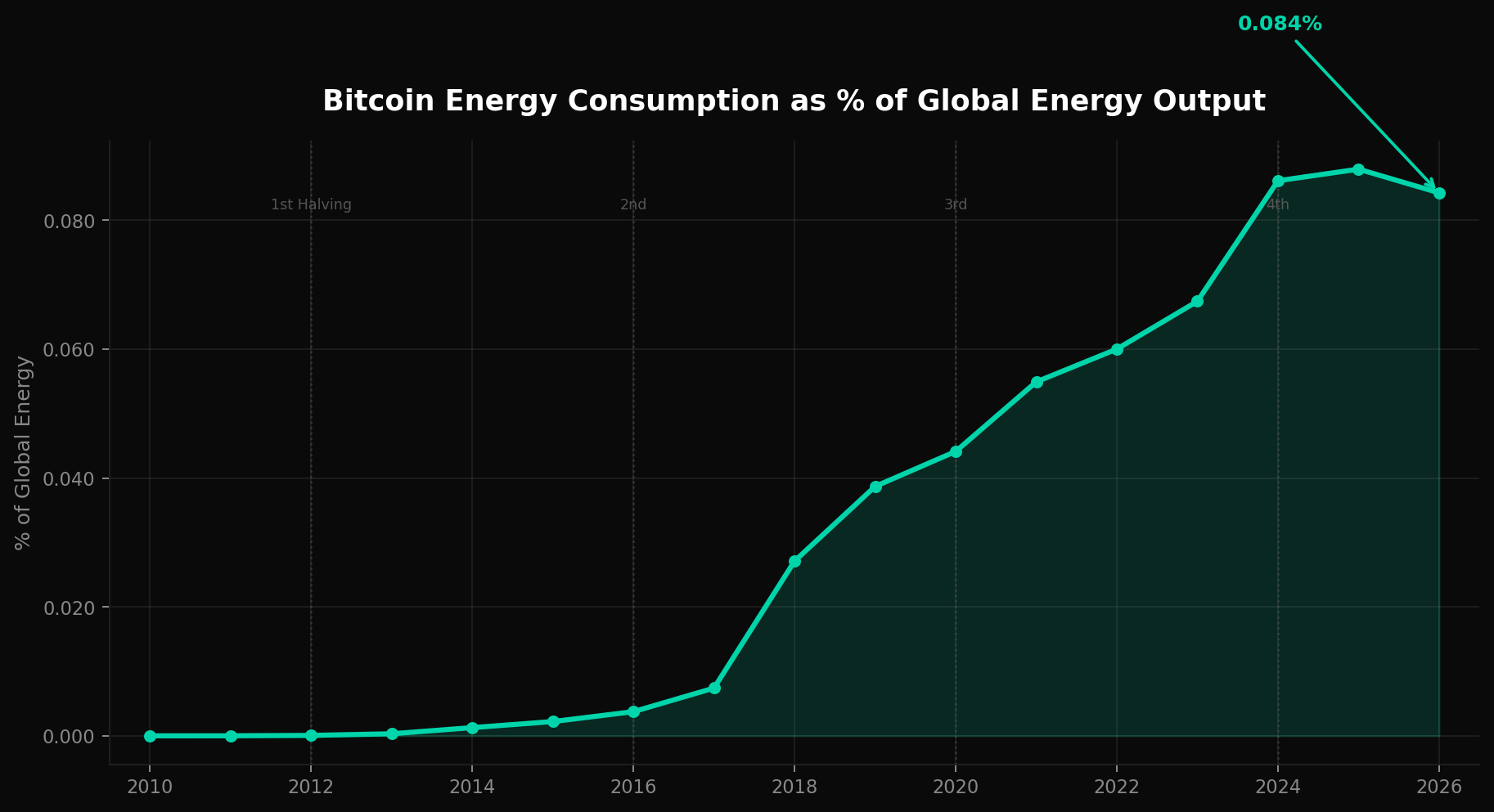
The implications extend beyond economics. The network's hashrate — currently measured in hundreds of exahashes per second — provides a precise lower bound on the energy capabilities of the civilization that maintains it. Bitcoin is, in effect, a thermodynamic certificate of existence.
Absolute Scarcity: A Mathematical Discovery
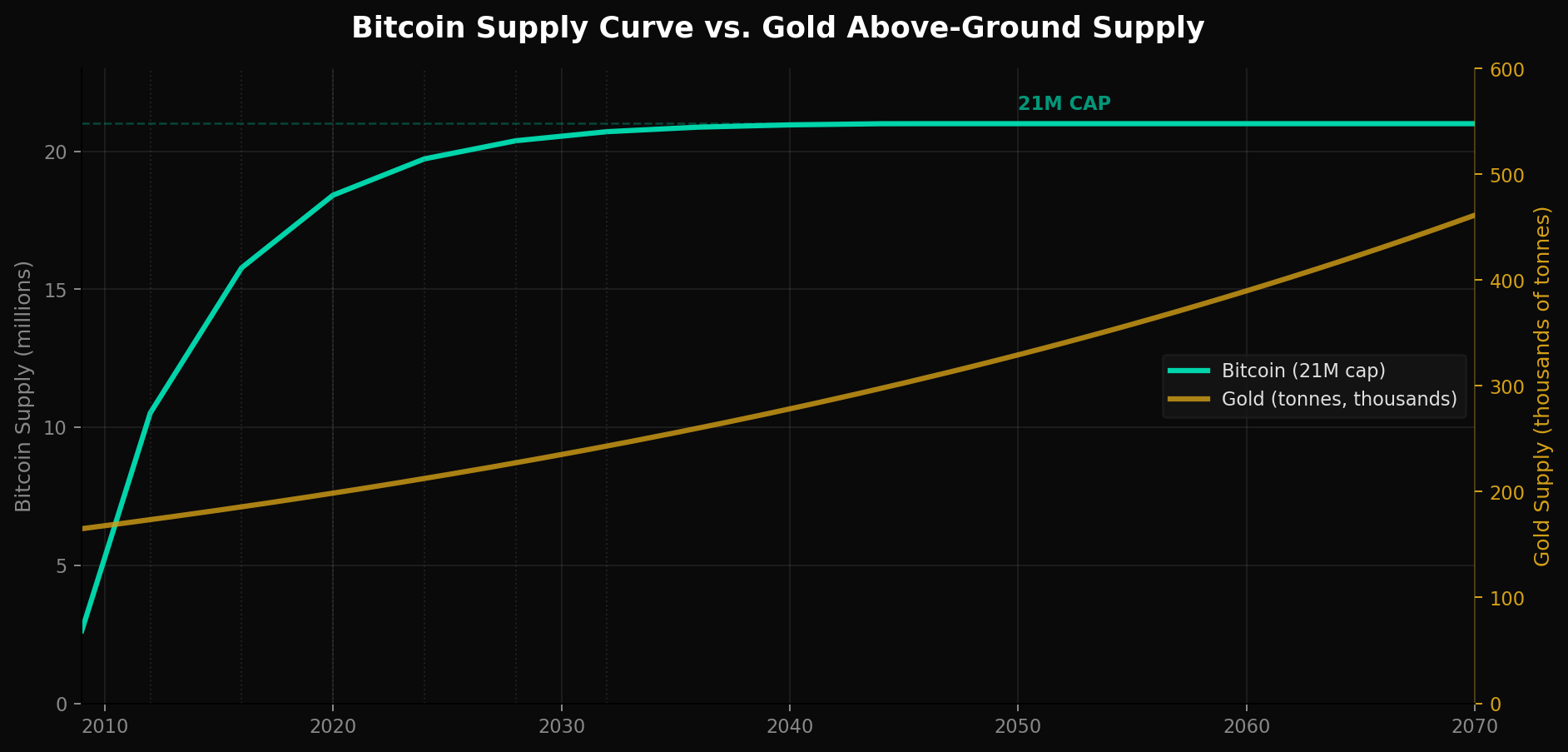
In the physical universe, scarcity is always relative. Gold is scarce on Earth's surface but abundant in the asteroid belt. Water is scarce in the Sahara but covers Europa. Even time, under relativity, is not uniform. Every physical commodity's supply responds to price — raise the price of gold enough, and more gets mined.
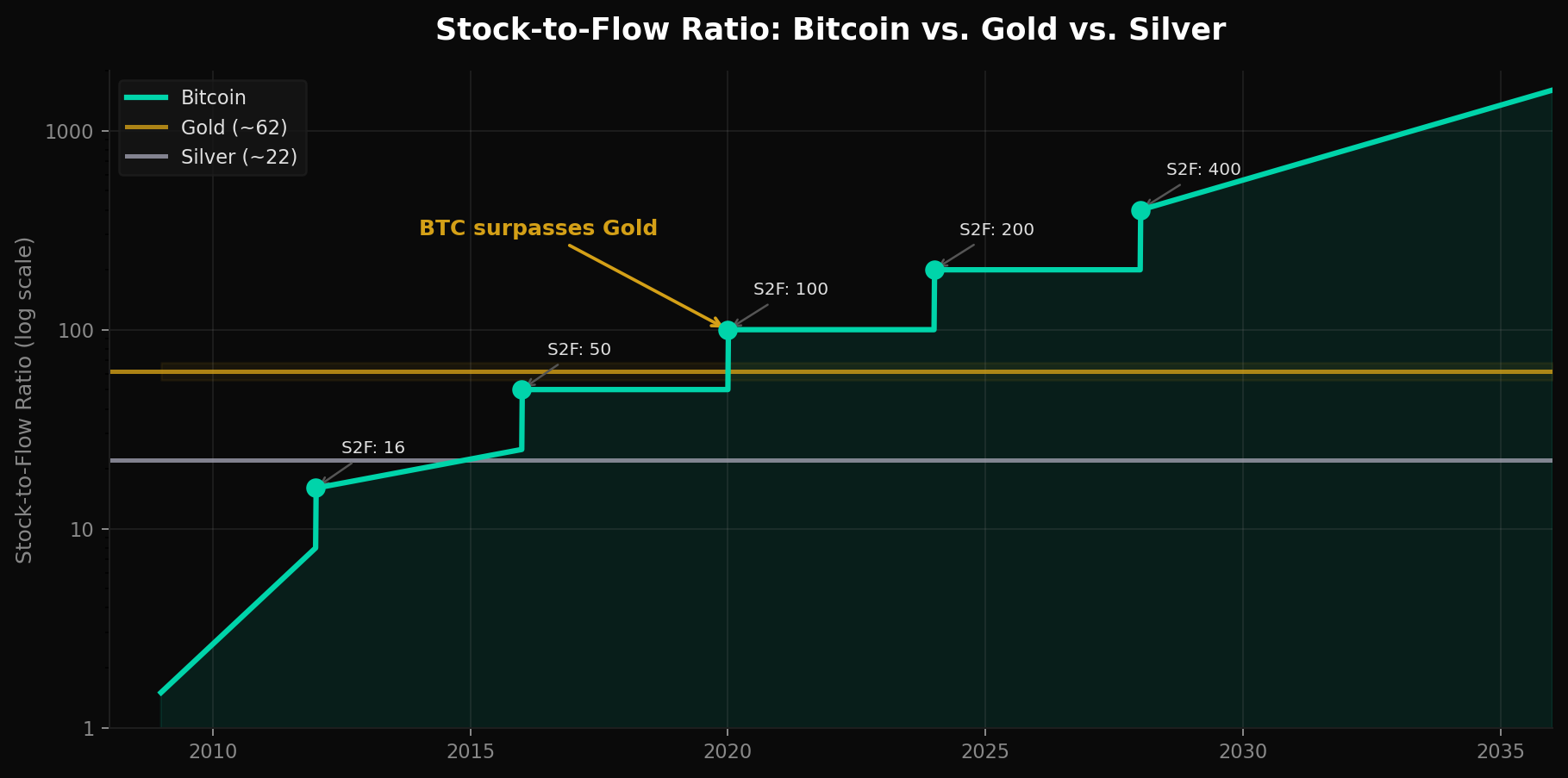
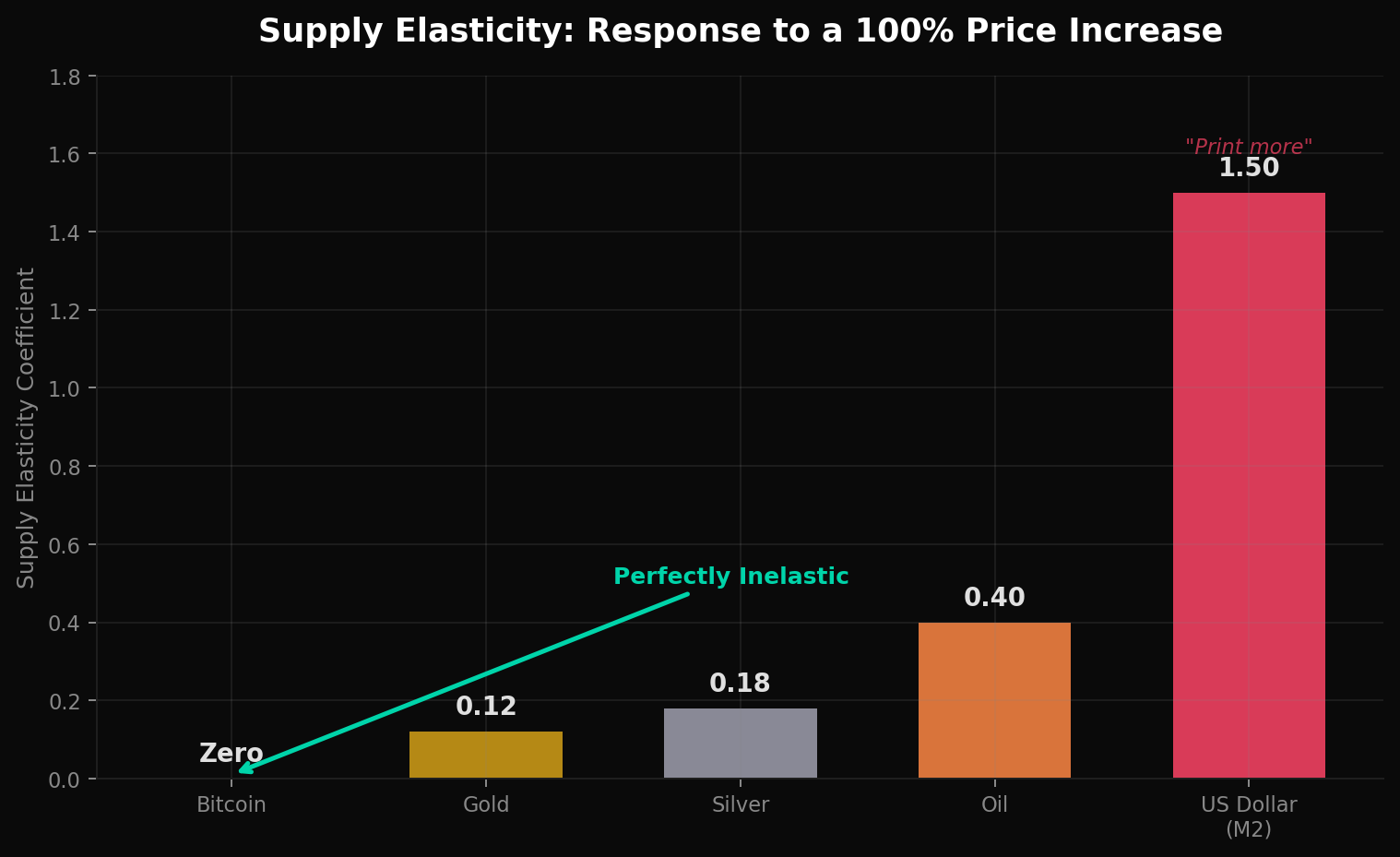
Bitcoin's 21 million unit cap is different in kind, not degree. It represents arguably the first widely deployed instance of absolute digital scarcity — a supply ceiling enforced by mathematics that is completely unresponsive to demand. When Bitcoin's price rises, more miners join the network, more energy is expended, difficulty adjusts upward — but the emission schedule does not change. More demand produces more security, not more coins.
The Difficulty Adjustment: The Engine of Inelasticity
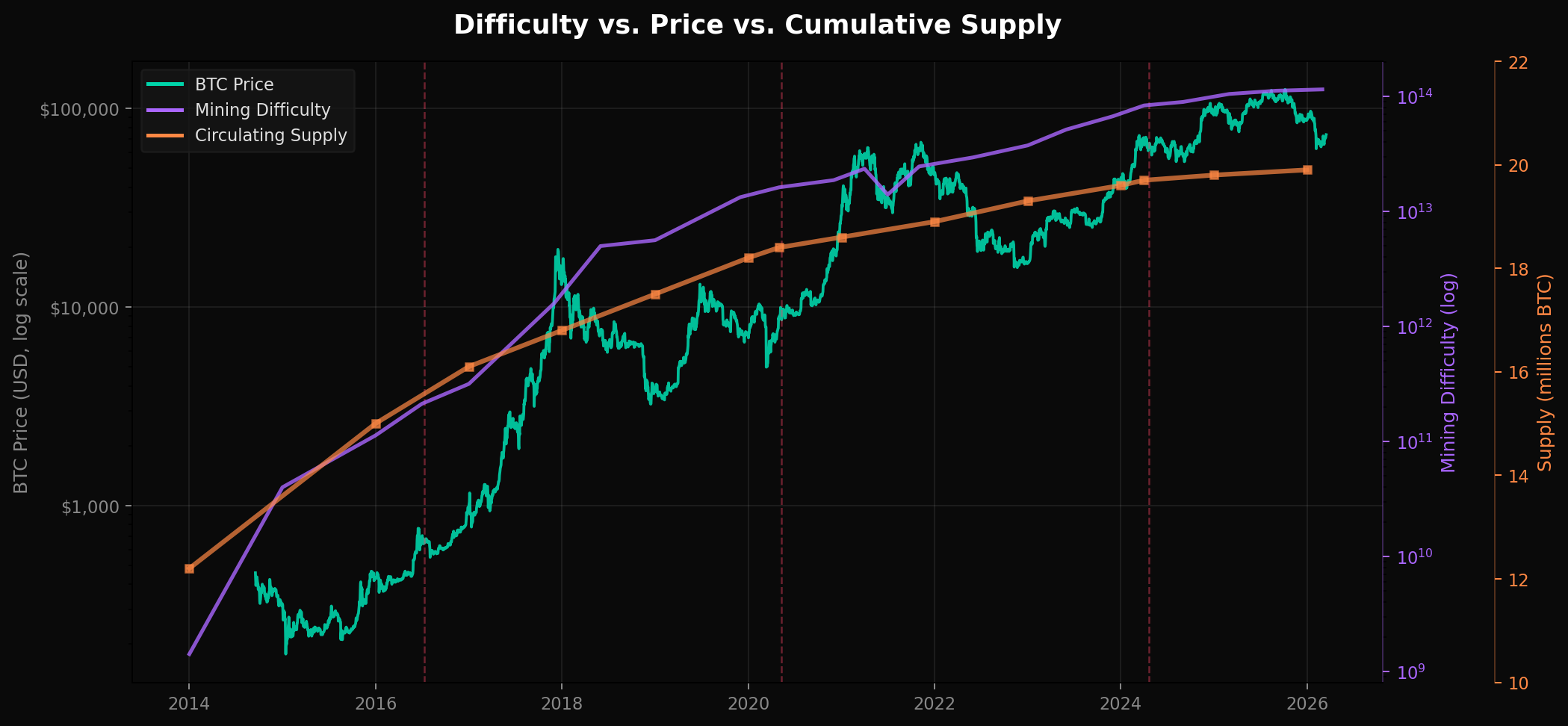
The difficulty adjustment algorithm is the mechanism that makes the store-of-value thesis work, and it is consistently underexplained. Every 2,016 blocks (~2 weeks), the network recalibrates the mining difficulty to maintain its 10-minute block target. If hashrate surges (more miners, more energy), difficulty rises. If hashrate drops, difficulty falls. The emission schedule stays locked.
This feedback loop appears to be unique among widely adopted stores of value. No other commodity or monetary system maintains a supply schedule that is provably, mathematically inelastic to demand at any price level. The chart below tells the story more clearly than any argument.
The Exponential Signal
The hashrate — the total computational power securing the network — has grown exponentially since 2009. Plotted on a log scale, this growth represents the compounding energy commitment of a global network of participants, each individually incentivized to secure the ledger.
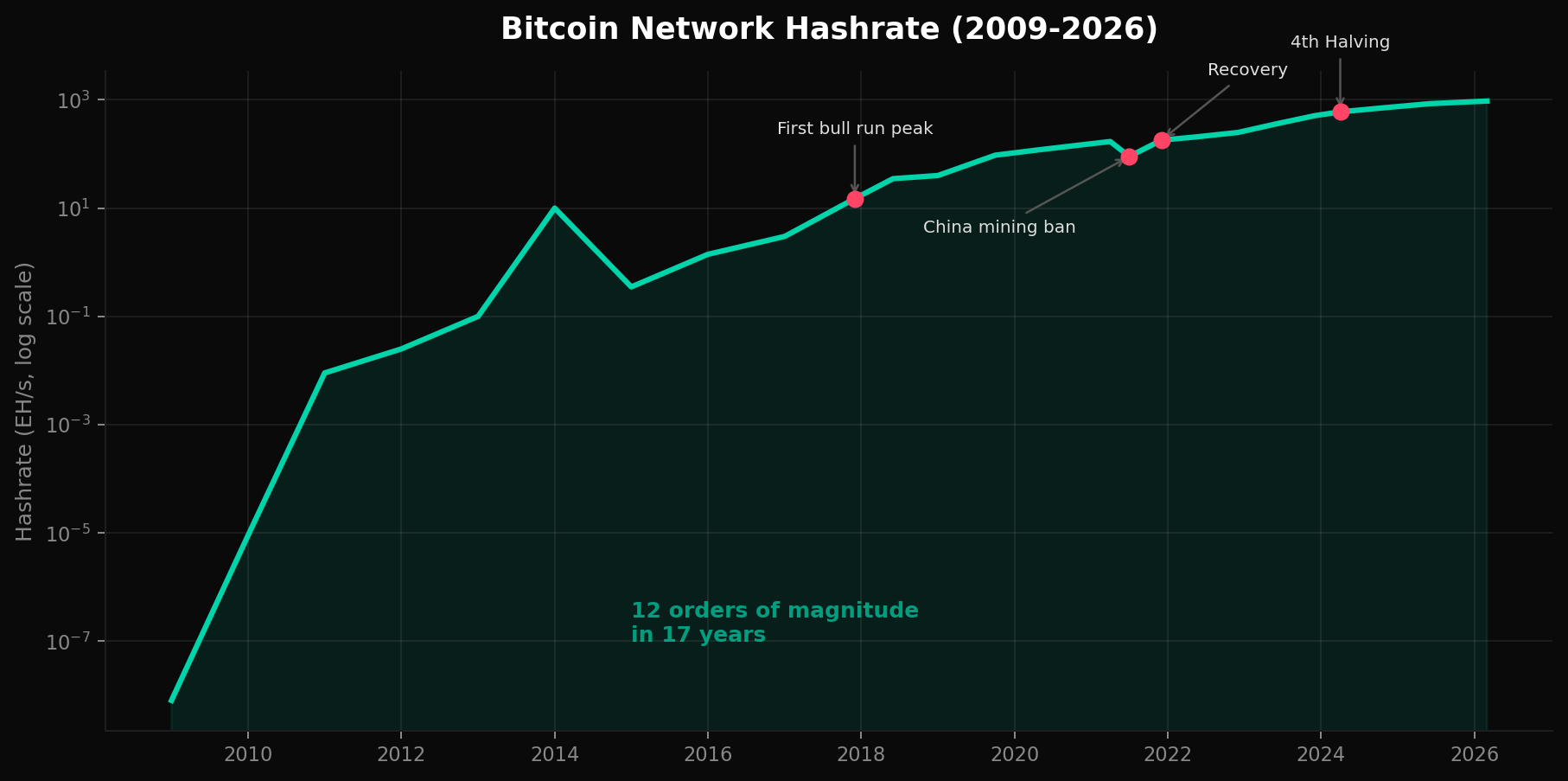
Each order of magnitude represents a tenfold increase in the cost of attacking the network. This compounding security is the Lindy effect made thermodynamic — the longer Bitcoin survives and the more energy secures it, the harder it becomes to break.
The Hash Horizon: A Physical Boundary
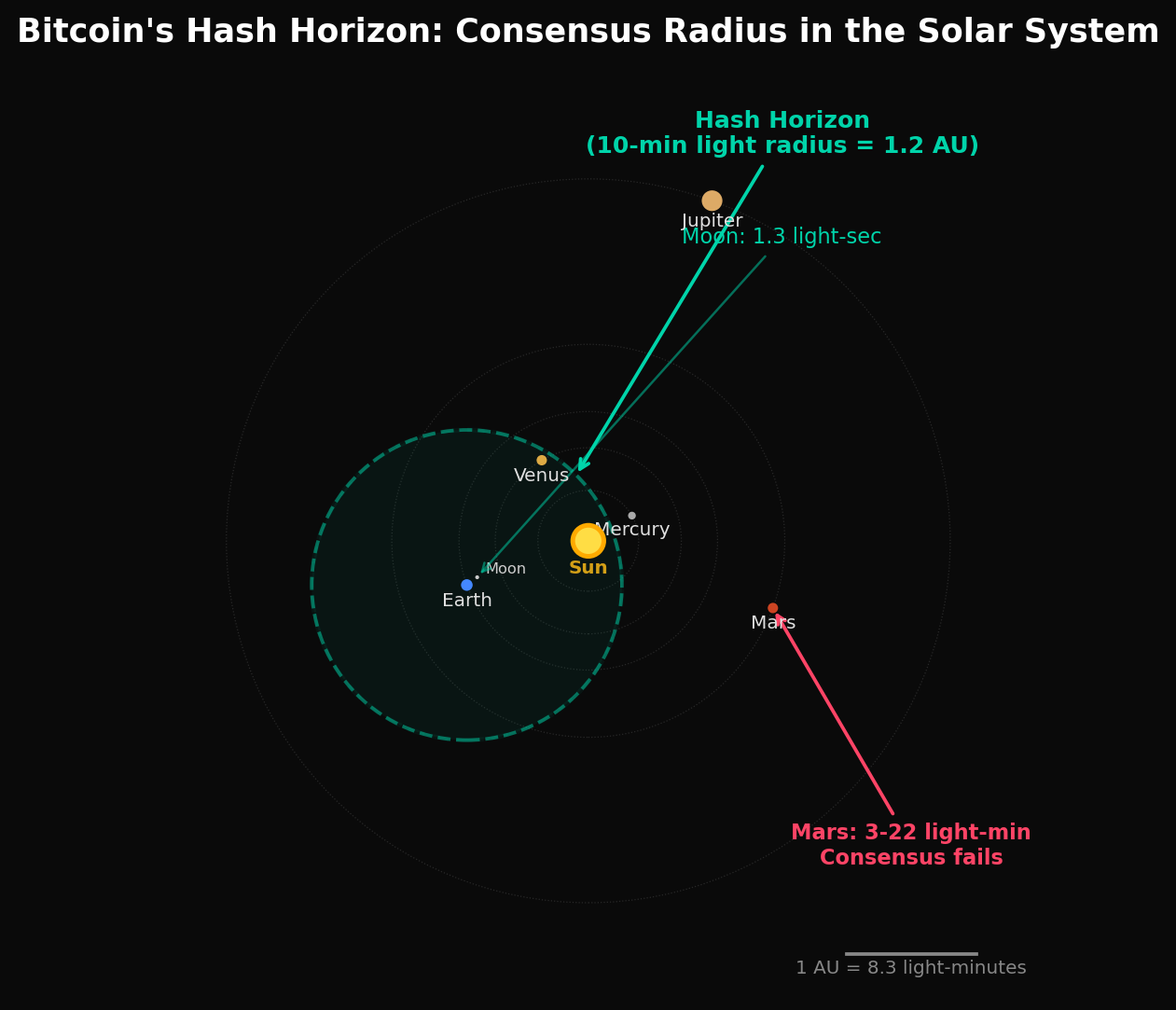
Bitcoin's 10-minute block time creates an often-overlooked physical constraint: the speed of light limits the practical radius within which consensus can function efficiently. A miner must receive and validate a new block before the next one is found. As signal delay approaches and exceeds the block time, orphan rates climb and consensus degrades — not as a clean cutoff, but as a gradient of increasing dysfunction.
Mars illustrates the problem. At an average distance of 12.5 light-minutes from Earth (ranging from 3 to 22 depending on orbital position), a Martian miner would consistently receive blocks after Earth miners have already moved on. Workarounds exist in theory — longer block times, localized chains — but Bitcoin as currently parameterized is effectively a planetary protocol. This is not a weakness of the store-of-value thesis; it is a demonstration of how deeply the protocol's properties are bound to physics rather than convention.
Survival as Proof
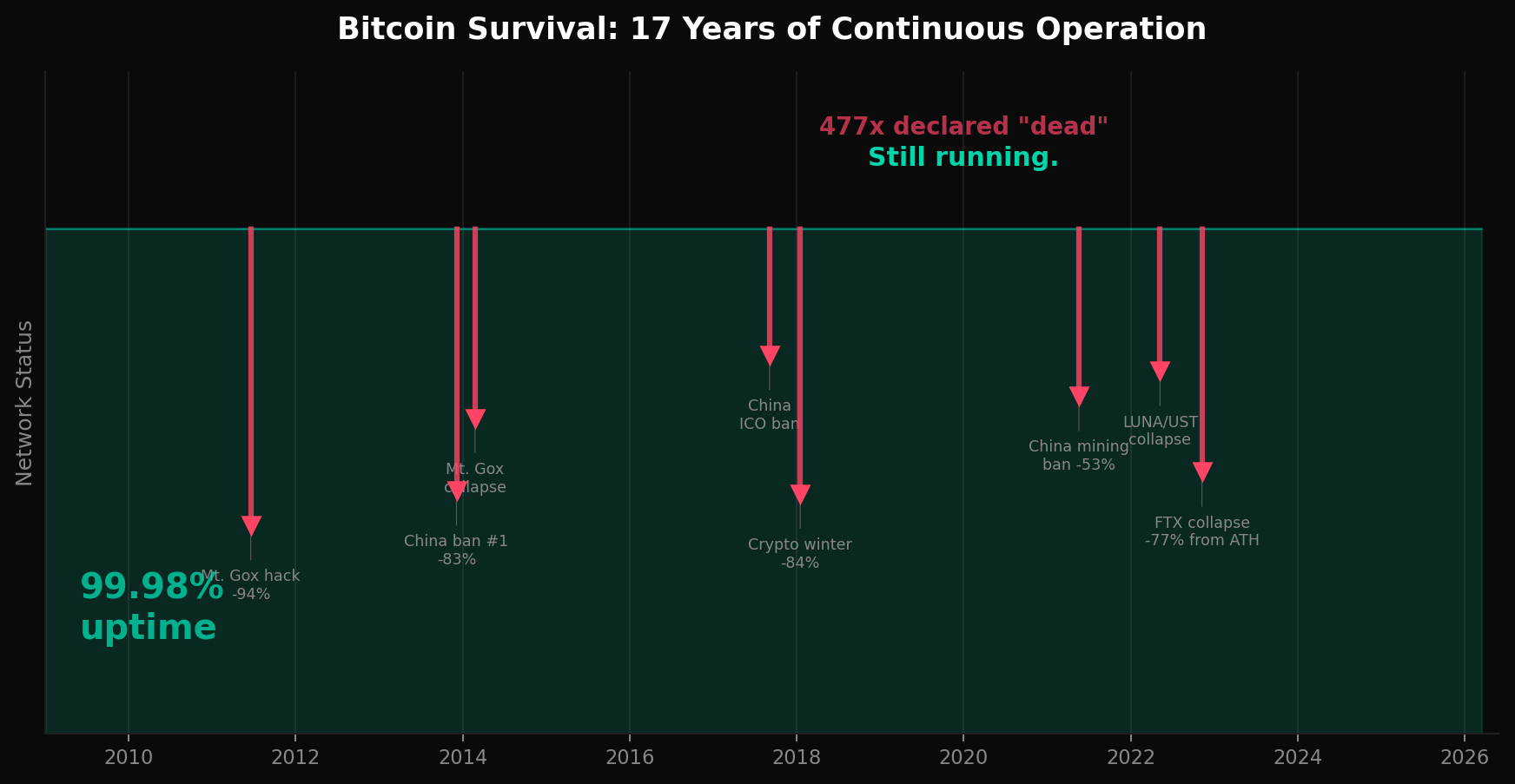
Bitcoin has operated continuously for 17 years with 99.98% uptime. It has survived nation-state bans, exchange collapses, 80%+ drawdowns, contentious hard fork attempts, and repeated declarations of death. Each survival event strengthens the case — not through narrative, but through the Lindy effect: the longer a non-perishable system persists, the longer its expected remaining lifespan.
The Counterargument
Bitcoin's mathematical properties are only as durable as the consensus to run the software. A coordinated majority could theoretically change the 21 million cap via a hard fork. This is the one genuine vulnerability in the store-of-value thesis — the scarcity is enforced by code, and code can be changed.
The counter to this counter: any fork that alters the cap would be rejected by the economic majority — nodes, exchanges, and holders — because doing so would destroy the very property that gives Bitcoin its value. This creates a self-reinforcing equilibrium: the 21 million cap is preserved precisely because it is valuable, and it is valuable precisely because it is preserved. The 2017 Block Size Wars demonstrated this dynamic empirically — the economic majority defended the protocol's core properties against a coalition of the largest miners and companies in the ecosystem.
Implications
The case for Bitcoin as a universal store of value does not rest on adoption metrics, institutional endorsement, or price prediction. It rests on properties that are verifiable by anyone with a computer and governed by laws that do not change: thermodynamics, mathematical scarcity, and game-theoretic equilibrium.
In a universe governed by entropy, the only honest signal of value is one that costs energy to produce and mathematics to verify. Bitcoin is the first human system that satisfies both constraints simultaneously.
Whether that makes it valuable to an alien civilization is an open question. Whether it makes it the strongest candidate yet discovered for any civilization constrained by physics, scarcity, and the need for trust-minimized coordination is a question the data increasingly supports.
Data Sources & Methodology
All charts were constructed from publicly available data. Price and hashrate data sourced from Yahoo Finance (BTC-USD) and public blockchain explorers. Energy consumption estimates draw on the Cambridge Bitcoin Electricity Consumption Index. Gold and silver supply figures use USGS and World Gold Council estimates. Stock-to-flow calculations use standard definitions (existing stock divided by annual production). The supply inelasticity comparison (Figure 5) uses estimated short-run elasticities from academic literature. The Hash Horizon diagram (Figure 7) uses average Earth-Mars distance of 12.5 light-minutes; actual latency varies from ~3 to ~22 minutes depending on orbital position. All charts reflect data through early 2026.
This analysis is for educational and informational purposes only. It does not constitute financial advice. All models are simplifications of reality — past patterns do not guarantee future outcomes.